Longjing tea (龍井茶 / lóngjǐng chá), commonly known as Dragon Well, is a green tea—an unoxidized tea celebrated for its "four excellences": jade color, rich aroma, mellow taste, and beautiful form. It ranks among China's most prestigious teas and represents the pinnacle of green tea craftsmanship.
Appearance: The Sparrow's Tongue
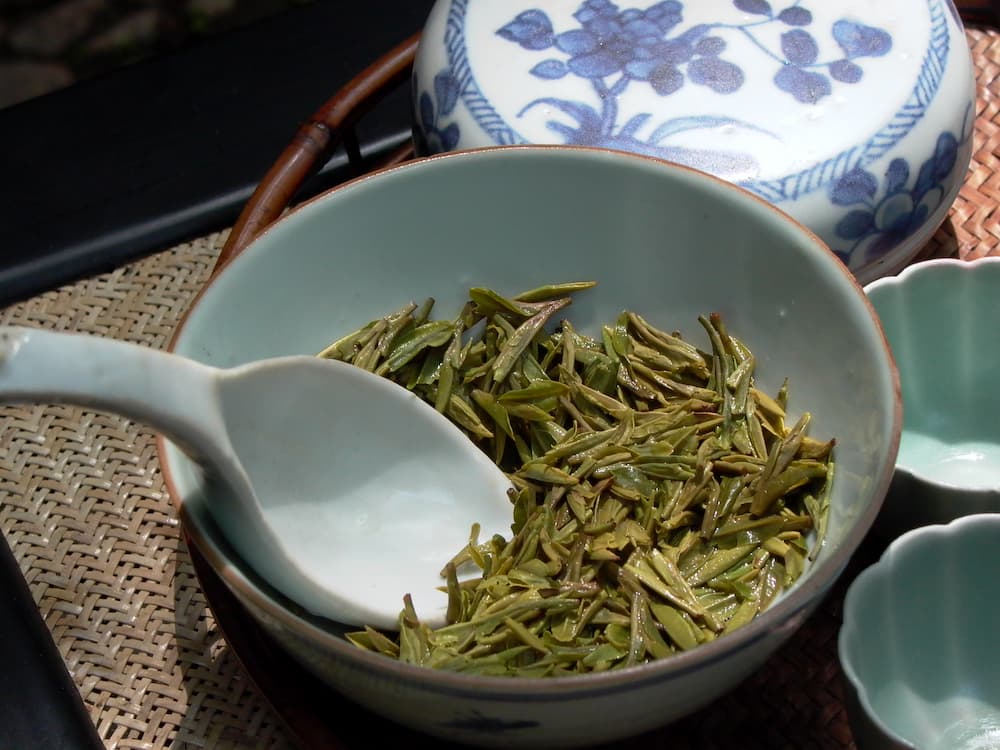
Longjing tea has a distinctive flat, smooth appearance, shaped like a "sparrow's tongue" (雀舌 / què shé) or described as "one flag, one spear" (一旗一槍 / yī qí yī qiāng)—referring to a single bud with one leaf attached. Premium-grade Longjing features tightly compressed, straight leaves with a lustrous emerald color.
Notably, Shifeng Longjing (獅峰龍井 / shīfēng lóngjǐng) from Lion Peak displays a natural brownish-yellow hue reminiscent of unpolished rice, distinctly different from the vivid green of other production areas. This coloration, once mistakenly seen as inferior, is now recognized as a mark of authenticity for the most prized origin.
Aroma and Flavor: The Taste Beyond Taste
Longjing's aroma is clear, elevated, and enduring, often carrying notes of fresh mung bean sprouts or roasted chestnuts. The flavor is fresh, sweet, and mellow—soft upon entry, never harsh or aggressive.
Classical descriptions speak of Longjing's "true sweetness and fragrance without sharpness, sipped lightly seeming almost flavorless." This "flavor of no flavor" (無味之味 / wú wèi zhī wèi) represents Longjing's ultimate character—a refined subtlety that rewards patient attention rather than demanding it.
The tea liquor displays a tender, bright green color, while the spent leaves settle as delicate, intact clusters at the bottom of the cup.
Origin and Harvest Timing
Longjing is famous for early harvesting: "Picked three days early, it's a treasure; three days late, it becomes grass." Tea harvested before the Qingming Festival (清明 / qīngmíng, around April 4-5) is called "pre-Qingming tea" (明前茶 / míngqián chá) and commands the highest quality and price. Tea picked before Grain Rain (穀雨 / gǔyǔ, around April 20) is called "pre-rain tea" (雨前茶 / yǔqián chá) and is considered second tier.
Within the West Lake production area, tea from Shifeng (Lion Peak), Longjing Village, Yunqi, and Hupao is most treasured. Among these, Shifeng Longjing is universally acknowledged as the apex.
Craftsmanship: The Art of the Pan
Authentic Longjing is hand-processed using a heated pan, following three key stages: qing guo (青鍋 / qīng guō, initial firing), hui chao (回潮 / huí cháo, moisture redistribution), and hui guo (輝鍋 / huī guō, final firing for shine).
Master tea crafters employ ten distinct hand techniques—shaking, carrying, pressing, throwing, straightening, spreading, buckling, grabbing, pressing, and grinding—to transform fresh leaves into that characteristic flat, smooth form. This requires extensive experience and refined skill; the best Longjing represents decades of accumulated expertise passed through generations.
Brewing Longjing
Unlike oolong, Longjing benefits from lower water temperatures—around 80°C is ideal to avoid scorching the delicate leaves. Use a glass cup to appreciate the leaves' graceful dance as they steep, standing upright like little soldiers before slowly settling.
Add water first, then tea (下投法 / xià tóu fǎ), or add a small amount of water, add tea, then top up (中投法 / zhōng tóu fǎ). Either method prevents the tender leaves from being shocked by too-hot water.
Longjing vs. Taiwan Oolong
For readers familiar with Taiwan high mountain oolong, Longjing represents a different tea philosophy entirely. Where oolong celebrates complex aromatics developed through partial oxidation, Longjing preserves the raw freshness of the unprocessed leaf. Where oolong's ball-rolled leaves need hot water to unfurl, Longjing's flat leaves release their essence gently into cooler water.
Both represent the heights of their respective styles—appreciating one enriches your understanding of the other.
[INTERNAL LINK: Comparing green tea and oolong tea]
