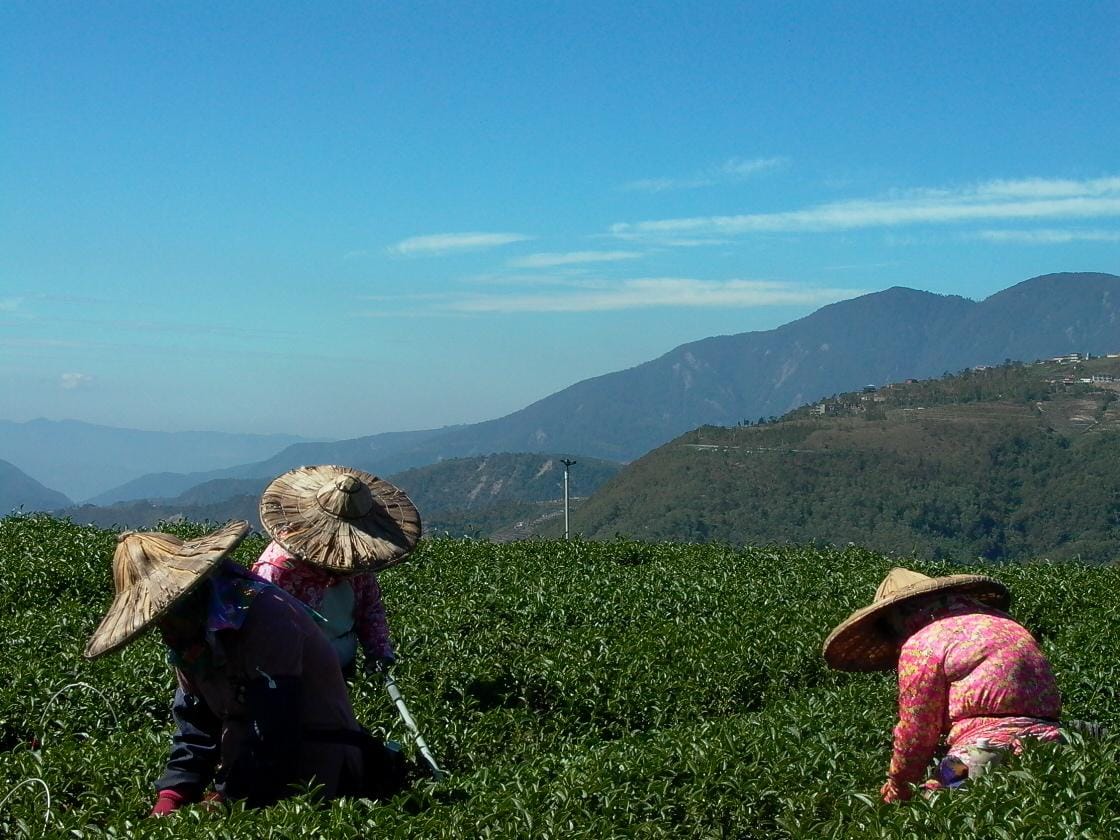
In Taiwan's tea landscape, one place always stands apart. Its elevation—roughly 600-750 meters—falls far short of the 1,000-meter threshold that defines "high mountain tea" by modern standards. Yet paradoxically, this region is called the birthplace of Taiwan's native tea, arguably the origin of the island's entire tea industry.
This place is Yuchi Township (魚池鄉 / Yúchí Xiāng) in Nantou County. While Alishan, Meishan, and Shanlinxi dominate the high-mountain tea spotlight, Yuchi quietly guards an important secret: Taiwan's tea industry DNA originates from this seemingly ordinary land.
Why did a region below 1,000 meters become Taiwan's tea birthplace? And how did it transform from the "ancestor" of Taiwan tea into today's specialty black tea producer?
The Secret Base of Native Tea: History Matters More Than Altitude
Yuchi Township earned its title as "Taiwan's early native tea region" not through elevation, but through historical depth. Long before the concept of high-mountain tea existed, Yuchi was already an important tea-producing area in Taiwan.
The term "native tea" (原生茶 / yuánshēng chá) carries special significance here. During Taiwan's early tea development, while other regions were still learning basic cultivation, Yuchi already possessed relatively mature tea-growing experience. These early tea varieties and cultivation techniques laid crucial foundations for Taiwan's entire tea industry.
Yuchi's geographic conditions, while not extreme, are remarkably stable and suitable. The 600-750 meter elevation provides a mild climate environment—not too hot from being too low, not growth-limiting from being too high. This "just right" environment allowed early tea farmers to focus on perfecting cultivation and processing techniques without battling extreme natural conditions.
The Tea Research Station's Strategic Choice: An Ideal Research Base
A key indicator of Yuchi's importance in Taiwan's tea history is the location of the Tea Research and Extension Station (茶業改良場 / Cháyè Gǎiliáng Chǎng). The decision to establish this crucial institution in Yuchi wasn't arbitrary—it reflected the region's unique position in Taiwan's tea ecosystem.
The research station's presence brought systematic scientific study to Taiwan's tea industry. Researchers here could work with diverse tea varieties under stable conditions, developing cultivation and processing techniques that would later spread throughout the island. Yuchi became not just a production region, but an innovation hub.
From Oolong Origins to Black Tea Specialty
Yuchi's transformation tells the broader story of Taiwan tea's evolution. In the early days, this region produced various tea types. But as Taiwan's high-mountain oolong industry developed and captured premium markets, Yuchi found its own distinctive path: Sun Moon Lake black tea (日月潭紅茶 / Rìyuètán hóngchá).
The region's stable climate and unique terroir proved ideal for black tea production. The Taiwan Tea No. 18, known as Ruby Black Tea (紅玉 / Hóngyù), has achieved international acclaim. Its natural cinnamon and mint notes come from the specific interaction of cultivar and terroir that only Yuchi can provide.
This pivot wasn't abandonment of heritage—it was evolution. Yuchi's tea-making expertise, accumulated over generations, found new expression in black tea craftsmanship. The precision and understanding of tea developed through decades of experience now serves a different but equally demanding specialty.
The Paradox of Tea Origin Stories
Yuchi's story reveals an important truth about tea regions: prestige and origin don't always align with current market categories. A region can be historically foundational without fitting contemporary definitions of "premium" tea areas.
When tea enthusiasts discuss Taiwan's great tea regions, they often default to listing high-mountain oolong producers. But this overlooks the deeper history—the places where Taiwan's tea knowledge was first developed, refined, and eventually exported to newer growing regions.
Yuchi represents this often-forgotten layer of Taiwan's tea heritage. Its contribution isn't measured in elevation meters or competition awards, but in the accumulated wisdom that made Taiwan's entire tea industry possible.
Conclusion: Respecting the Roots
Understanding Yuchi's role enriches appreciation of Taiwan tea. That cup of high-mountain oolong you're enjoying exists partly because farmers in Yuchi, generations ago, developed the foundational knowledge that others would later apply at higher elevations.
And Yuchi itself continues to thrive, having found its own specialty rather than competing in categories where geography works against it. Sun Moon Lake black tea stands as proof that tea excellence takes many forms—and that sometimes the most interesting stories come from places that don't fit easy categories.
The next time someone asks about Taiwan's most important tea regions, consider mentioning Yuchi. Not for its elevation, but for its irreplaceable role in making Taiwan the tea island it is today.